Explore our network of country and industry based websites to access localized information, product offerings, and business services across our group.
Log in to start sending quotation requests for any product.
Don't have an account? Sign Up Here
Home Cashew Applications and B2B Market Opportunities for Food Buyers
Trade Insights | Applications and Buyers | 10 August 2026
Cashew’s Role in the Commercial Food Ingredient Market
Cashew Applications Across Food Manufacturing
Cashew in Bakery and Confectionery Production
Cashew for Snacks, Plant-Based Foods and Foodservice
Key B2B Buyers and Procurement Requirements
Cashew Sourcing, Quality and Supply-Chain Considerations
Market Outlook and Commercial Opportunities
Building a Reliable Cashew Sourcing Strategy
Conclusion: Cashew as a Strategic Food Ingredient
Sources
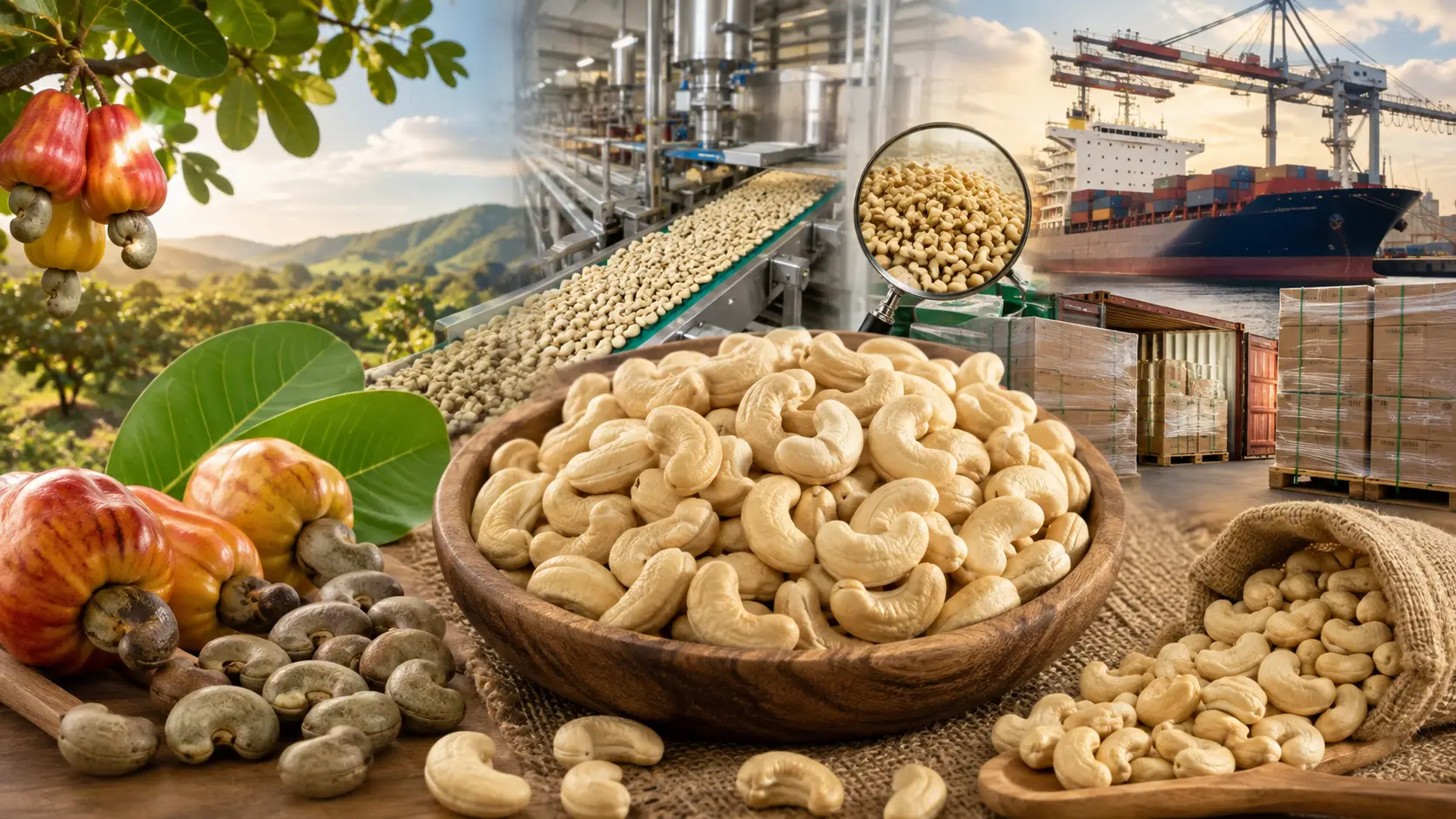
Cashew is a globally traded nut with an established role in food manufacturing, ingredient distribution and consumer food markets. For B2B buyers, its commercial value extends beyond direct consumption because cashew can be incorporated into multiple finished-product categories, including snacks, bakery products, confectionery, prepared foods and plant-based formulations. The International Nut and Dried Fruit Council reports that cashews represented 18% of global tree-nut consumption in 2024, demonstrating their significant position within the international nut category.
The commercial attractiveness of cashew comes from its adaptability. Manufacturers can source kernels and process them into formats suited to specific applications, allowing the same agricultural product to serve different product-development strategies. Depending on the intended application, buyers may prioritize whole kernels, pieces, splits, roasted material, or other processed formats. This makes cashew relevant to manufacturers seeking both a recognizable ingredient and a versatile input for formulated foods.
The cashew supply chain connects growers, processors, traders, distributors, food manufacturers and retailers. The INC identifies companies across these categories as participants in the nut and dried-fruit value chain, highlighting the importance of commercial coordination from origin through final market. For procurement teams, this structure means that sourcing decisions involve more than price: origin, processing capability, consistency, food-safety controls and logistics can all influence the commercial value of a shipment.
Cashew therefore presents a broad B2B opportunity for suppliers serving food manufacturers and distributors. Rather than positioning the ingredient around one narrow use, suppliers can address several demand centers simultaneously, from industrial bakery and confectionery to snack manufacturing and foodservice. This broad application base gives cashew strategic relevance for buyers seeking ingredients that can support multiple product lines while maintaining a recognizable premium food profile.
Cashew is used in food manufacturing where manufacturers want to introduce nut character, texture and richness into finished products. It can appear as a visible ingredient in formulated foods or as a processed component incorporated into recipes. Its application flexibility allows product developers to adjust particle size and processing format according to the technical requirements of the finished product, making specification alignment an important part of commercial sourcing.
In industrial food production, cashew can contribute both sensory and formulation value. Whole or larger pieces can provide visible texture, while smaller pieces can be incorporated into fillings, coatings, mixes and prepared foods. Cashew can also be processed into pastes or other ingredient formats where manufacturers require a more integrated nut profile. These options allow procurement teams to match the physical characteristics of the ingredient with production requirements.
Although roasted and salted cashews remain familiar consumer products, industrial demand is not limited to packaged snacks. Cashew can be incorporated into cereals, nut mixes, desserts, sauces, spreads and other prepared foods. This application diversity is particularly relevant to ingredient distributors because different customer segments may require different grades or specifications from the same underlying commodity.
Processing is an important commercial bridge between raw agricultural production and finished food applications. The cashew industry involves specialized processing and food-safety considerations, and the INC maintains technical resources covering cultivation, harvesting, processing, food safety and quality standards across the nut and dried-fruit sector. For B2B suppliers, understanding processing formats helps translate a general cashew offering into a specification that is meaningful to industrial customers.
Bakery manufacturers use nuts to add texture, visual appeal and differentiated flavor to finished products, and cashew can fit this role across a range of formulations. It can be incorporated into cookies, biscuits, cakes, pastries, bars and specialty bakery products. Depending on the recipe, manufacturers may require whole kernels, chopped pieces or smaller particles, making size consistency and physical specifications important purchasing considerations.
Confectionery represents another significant application pathway for cashew. Manufacturers can use cashew in chocolate products, nut-based centers, praline-style formulations, coated products and premium confectionery. In these applications, consistency becomes particularly important because variation in kernel size, appearance, flavor or processing condition can affect production efficiency and the sensory characteristics of the final product.
Cashew is particularly useful when product developers want to combine a familiar nut ingredient with a premium positioning. Pieces can provide crunch, while processed cashew ingredients can contribute a smoother nut profile. For manufacturers competing in crowded bakery and confectionery categories, these characteristics can support product differentiation without requiring an entirely new ingredient platform.
Bakery and confectionery buyers should therefore evaluate cashew according to the finished product rather than treating every cashew specification as interchangeable. Required particle size, color, flavor, moisture characteristics, packaging, shelf-life expectations and processing condition may differ by application. A supplier capable of translating these requirements into a consistent commercial specification can provide greater value than a supplier competing solely on nominal commodity price.
Snack production remains one of the most direct commercial applications for cashew. Manufacturers can sell cashew as a standalone roasted product or incorporate it into mixed-nut products, snack blends and value-added formats. The category creates opportunities for suppliers able to provide consistent kernels suitable for roasting, seasoning, coating and packaging operations, while processors must maintain quality throughout handling and storage.
Cashew can also support plant-based food formulation because its sensory and physical characteristics allow it to be incorporated into dairy-alternative and other formulated foods. Depending on processing methods, cashew may contribute body, richness and nut flavor to products such as plant-based creams, sauces and desserts. This creates an additional commercial route for cashew suppliers serving food manufacturers rather than only traditional nut processors.
Foodservice operators and distributors create another buyer segment for cashew. These customers may require formats that are convenient for kitchens, bakeries, catering businesses or prepared-food manufacturers. Distributors can also consolidate demand from smaller commercial users, making reliable packaging, product consistency and documentation important elements of the B2B proposition.
These applications demonstrate why cashew should be evaluated as a multi-market ingredient rather than a single-category commodity. Snack manufacturers, foodservice distributors, bakery companies and plant-based food producers can all generate demand, but their specifications and purchasing patterns may differ. For suppliers, identifying these differences creates opportunities to develop application-specific offers and build longer-term customer relationships.
Food manufacturers represent one of the most important buyer groups for commercially supplied cashew. Their purchasing decisions are generally linked to production volumes, recipe specifications, quality requirements and continuity of supply. Large manufacturers may require structured documentation and repeatable specifications because ingredient variation can affect production performance and finished-product consistency.
Ingredient distributors purchase cashew to serve multiple downstream customers, which makes flexibility particularly valuable. A distributor may need different grades, pack sizes or processing formats for different clients. For these buyers, a supplier's ability to communicate specifications clearly and maintain dependable fulfillment can be as important as the initial quoted price.
Bakery and confectionery procurement teams typically assess cashew according to application-specific requirements. A manufacturer producing premium chocolate products may emphasize appearance and kernel integrity, while a biscuit producer may have greater interest in pieces or cost-efficient formats. The commercial specification should therefore be linked directly to the production process and finished-product requirements.
B2B buyers should compare suppliers using a combination of product specification, food-safety documentation, origin information, processing capability, packaging, logistics and commercial terms. The INC highlights food safety, regulatory compliance, international trade requirements and technical standards as important areas within the global nut and dried-fruit industry. A structured procurement process helps buyers avoid evaluating offers purely on price when differences in quality or supply reliability could create higher downstream costs.
Cashew sourcing begins with understanding where the product originates and where processing takes place. Global trade can involve movement from producing regions to processing centers and then to consumption markets, creating multiple logistical stages. Historical INC trade data has identified Western Africa as a major exporting origin for raw cashew nuts, while Asian countries have played major roles in importing and processing raw material.
Quality is central to commercial cashew procurement because the ingredient ultimately enters food production. Buyers should establish clear requirements for kernel appearance, size, physical condition, flavor, cleanliness, packaging and other relevant specifications before placing recurring orders. This provides a common technical reference between supplier and buyer and reduces the risk of misunderstandings during international trade.
Food-safety management is another critical consideration. International nut trade involves requirements relating to food safety, quality, labeling and regulatory compliance that can differ between destination markets. The INC maintains an extensive regulatory and technical resource base covering international standards, food-control systems, labeling and trade regulations, reinforcing the importance of compliance-oriented sourcing for professional buyers.
Cashew is also a supply-chain product, so procurement teams must consider lead times, shipment planning, packaging integrity and inventory requirements. A competitive supplier should be able to provide practical information about product availability and shipping conditions rather than offering only a nominal unit price. For manufacturers operating continuous production, supply continuity can ultimately be more valuable than a marginally lower purchase price.
The global nut market provides a substantial commercial environment for cashew. According to the INC's 2025 Global Statistical Review, Asia represented 47% of global tree-nut consumption in 2024, followed by Europe at 30% and North America at 16%. Cashew's 18% share of global tree-nut consumption places it among the major commercially consumed tree nuts.
For suppliers and traders, regional demand patterns can guide market-development strategies. Asia's large consumption base provides significant opportunities for processors, distributors and food manufacturers, while European and North American markets remain important destinations for value-added nut products. The commercial opportunity is therefore not restricted to one geography but distributed across multiple consumption and manufacturing centers.
Market opportunities also exist beyond trading standard kernels. Processed formats, application-specific grades and ingredients designed for particular food categories can help suppliers move closer to the needs of manufacturers. This approach can strengthen commercial positioning because buyers increasingly need products that integrate smoothly into established production processes rather than simply purchasing an agricultural commodity.
For B2B suppliers, market competition is likely to be influenced by a combination of quality, availability, documentation, service and pricing. The INC's industry resources emphasize trade information, statistics, sustainability, scientific research and regulatory developments as relevant dimensions of the global nut industry. Suppliers that combine commercial competitiveness with transparent product information can therefore be better positioned to serve professional procurement teams.
Effective sourcing begins with the end use. A buyer purchasing cashew for bakery, confectionery, snack production or plant-based formulation should define the application before requesting quotations. This allows the supplier to recommend an appropriate physical format and reduces the risk of purchasing a product that is technically acceptable but inefficient for the intended manufacturing process.
Supplier qualification should consider product consistency, documentation, processing capability, communication and supply reliability. For international buyers, the ability to support regulatory and quality documentation is particularly important because imported food ingredients may be subject to destination-market requirements. A structured qualification process also gives procurement teams a consistent basis for comparing competing suppliers.
The lowest quoted cashew price does not necessarily represent the lowest overall procurement cost. Quality deviations, inconsistent sizing, rejected shipments, additional processing requirements or delayed deliveries can increase the effective cost of an ingredient. Buyers should therefore assess total commercial value, including product quality, logistics, documentation and supplier responsiveness.
Digital B2B marketplaces can simplify supplier discovery and improve communication between buyers, traders and manufacturers. For a product such as cashew, a marketplace model can be particularly useful because demand comes from several industries and geographic markets. A well-structured supplier listing should communicate product specifications, applications, sourcing capability and commercial requirements clearly so qualified buyers can evaluate opportunities efficiently.
Cashew has commercial relevance across multiple food categories, giving suppliers access to diverse B2B demand. Its applications span snacks, bakery, confectionery, prepared foods, plant-based formulations and foodservice, while different processing formats allow manufacturers to tailor the ingredient to specific production requirements. This diversity supports cashew's role as a flexible food ingredient rather than a commodity limited to direct consumption.
For procurement teams, successful cashew sourcing depends on the relationship between application, specification, quality and supply continuity. Buyers increasingly need suppliers that can provide dependable product information and align shipments with manufacturing requirements. This creates room for commercially focused suppliers and distributors that understand both the product and the operational priorities of industrial customers.
A disciplined sourcing strategy can help manufacturers manage quality, supply risk and purchasing efficiency. Comparing suppliers according to specification, documentation, origin, processing, logistics and commercial terms gives procurement teams a more complete view of value. For suppliers, understanding these decision factors creates an opportunity to build recurring B2B business instead of competing only on transactional pricing.
For businesses seeking to source cashew for food manufacturing and distribution, Tradeasia International / Chemtradeasia / Tradechem Marketplace can be positioned around connecting commercial buyers with relevant ingredient supply opportunities. The strongest value proposition is not simply access to cashew, but a sourcing approach that connects product requirements with dependable B2B trade, application needs and international market opportunities.
International Nut & Dried Fruit Council
We're committed to your privacy. Tradeasia uses the information you provide to us to contact you about our relevant content, products, and services. For more information, check out our privacy policy.


 English
 Indonesian
 简体字
简体字
 العربية
 Español
 Français
 Português
 日本語
日本語
 한국어
한국어
 Tiếng Việt