Explore our network of country and industry based websites to access localized information, product offerings, and business services across our group.
Log in to start sending quotation requests for any product.
Don't have an account? Sign Up Here
Home Monosodium Glutamate (MSG) Industrial Uses and B2B Sourcing Guide
Trade Insights | Applications and Buyers | 26 June 2026
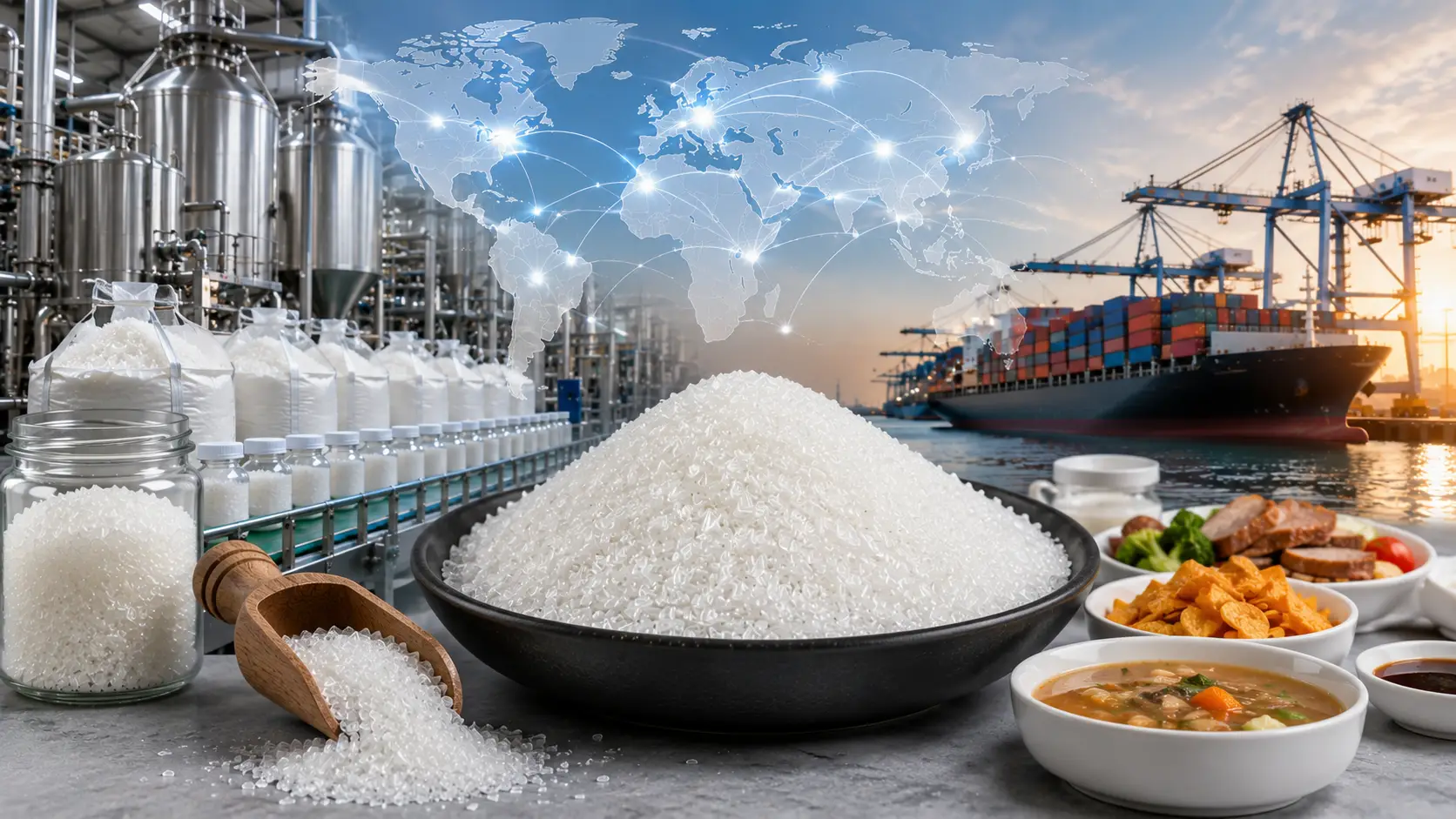
Introduction to Monosodium Glutamate in Food Industry
Industrial Applications of Monosodium Glutamate
Global Market Demand and Consumption Trends
Quality Standards and Regulatory Framework
B2B Sourcing Considerations for MSG Buyers
Future Outlook and Procurement Strategies
Monosodium glutamate (MSG) is a widely used flavor enhancer that plays a central role in global food manufacturing. According to the U.S. Food and Drug Administration (FDA), MSG is classified as Generally Recognized as Safe (GRAS), making it a standard ingredient in processed food applications across international markets. Its ability to enhance umami taste has positioned it as a key additive in industrial food formulation.
MSG functions by stimulating specific taste receptors responsible for umami perception, one of the five basic tastes identified in food science research. The umami effect intensifies savory profiles in protein-rich foods, soups, and seasoning bases, making it highly valuable for manufacturers aiming to improve flavor efficiency.
From a chemical perspective, MSG is the sodium salt of glutamic acid, an amino acid naturally present in many foods such as tomatoes and cheese. Its industrial production ensures consistency, purity, and scalability for large-scale food operations requiring stable flavor profiles.
The food processing industry relies on MSG not only for taste enhancement but also for cost optimization, as it reduces the need for high quantities of natural flavoring ingredients. This makes it particularly relevant in mass production environments.
Monosodium glutamate is extensively used across processed food categories, particularly in seasoning blends, instant noodles, snacks, and ready-to-eat meals. The Food and Agriculture Organization (FAO) recognizes MSG as an important food additive in supporting global food security and flavor standardization.
In processed foods, MSG enhances the overall sensory profile by intensifying meat, broth, and vegetable flavors. It is commonly used in canned soups, frozen meals, and processed meats where flavor consistency is essential.
Food manufacturers integrate MSG into formulation systems to maintain stable taste across production batches. This ensures consumer satisfaction and brand consistency in highly competitive FMCG markets.
Its compatibility with other seasoning agents allows flexible formulation in complex food systems, making it a preferred ingredient in industrial kitchens and large-scale production facilities.
The global demand for MSG continues to grow, driven by rising consumption of processed and convenience foods. Market analysis reports from industry research organizations indicate strong growth in Asia-Pacific due to urbanization and changing dietary patterns.
Emerging economies are witnessing increased demand for affordable flavor enhancers as processed food consumption expands. MSG plays a critical role in meeting this demand by providing cost-effective flavor enhancement solutions.
Urban lifestyles and growing foodservice sectors contribute significantly to MSG consumption. Restaurants and institutional catering services rely on MSG to maintain consistent taste at scale.
The expansion of quick-service restaurants and packaged food brands further accelerates demand, reinforcing MSG’s position as a core food additive in global supply chains.
MSG is regulated under international food safety standards, with organizations such as the European Food Safety Authority (EFSA) and the Joint FAO/WHO Expert Committee on Food Additives (JECFA) confirming its safety within established consumption limits.
Food manufacturers must comply with strict labeling and dosage regulations when using MSG in food products. These regulations ensure consumer safety and transparent ingredient disclosure.
Different regions maintain specific permissible usage levels, requiring suppliers and buyers to stay informed about regulatory variations in target markets.
Compliance with food safety standards is essential for exporters and distributors involved in international MSG trade, ensuring smooth market access and reduced regulatory risks.
For procurement teams, sourcing monosodium glutamate involves evaluating product purity, supplier reliability, pricing stability, and compliance documentation. Trade platforms such as Tradeasia and Chemtradeasia play a key role in connecting buyers with verified suppliers in the global chemical supply chain.
Buyers typically assess MSG suppliers based on production consistency, certification standards, and logistics capabilities. Reliable sourcing ensures uninterrupted supply for continuous food manufacturing operations.
Bulk procurement strategies are commonly used by food manufacturers to stabilize costs and secure long-term supply contracts. This is especially important in high-volume production environments.
Digital chemical marketplaces simplify procurement by offering transparent product specifications, enabling buyers to compare suppliers efficiently and make informed purchasing decisions.
The future of MSG demand is closely tied to the expansion of processed food consumption and the need for cost-effective flavor enhancement solutions. Industry forecasts suggest steady growth supported by evolving global food habits.
Food manufacturers are increasingly focusing on optimizing flavor systems while reducing sodium content, where MSG plays a complementary role. This aligns with broader health-driven formulation trends.
Advancements in food technology are enabling more efficient use of MSG in combination with other natural flavor enhancers. This supports cleaner label strategies while maintaining taste performance.
For B2B buyers, strategic procurement will continue to emphasize supply chain resilience, supplier diversification, and compliance-driven sourcing practices in the global MSG market.
Sources
We're committed to your privacy. Tradeasia uses the information you provide to us to contact you about our relevant content, products, and services. For more information, check out our privacy policy.


 English
 Indonesian
 简体字
简体字
 العربية
 Español
 Français
 Português
 日本語
日本語
 한국어
한국어
 Tiếng Việt



















