Explore our network of country and industry based websites to access localized information, product offerings, and business services across our group.
Log in to start sending quotation requests for any product.
Don't have an account? Sign Up Here
Home Diammonium Phosphate Supply Chain: Global B2B Sourcing
Trade Insights | Supply Chain | 13 August 2026
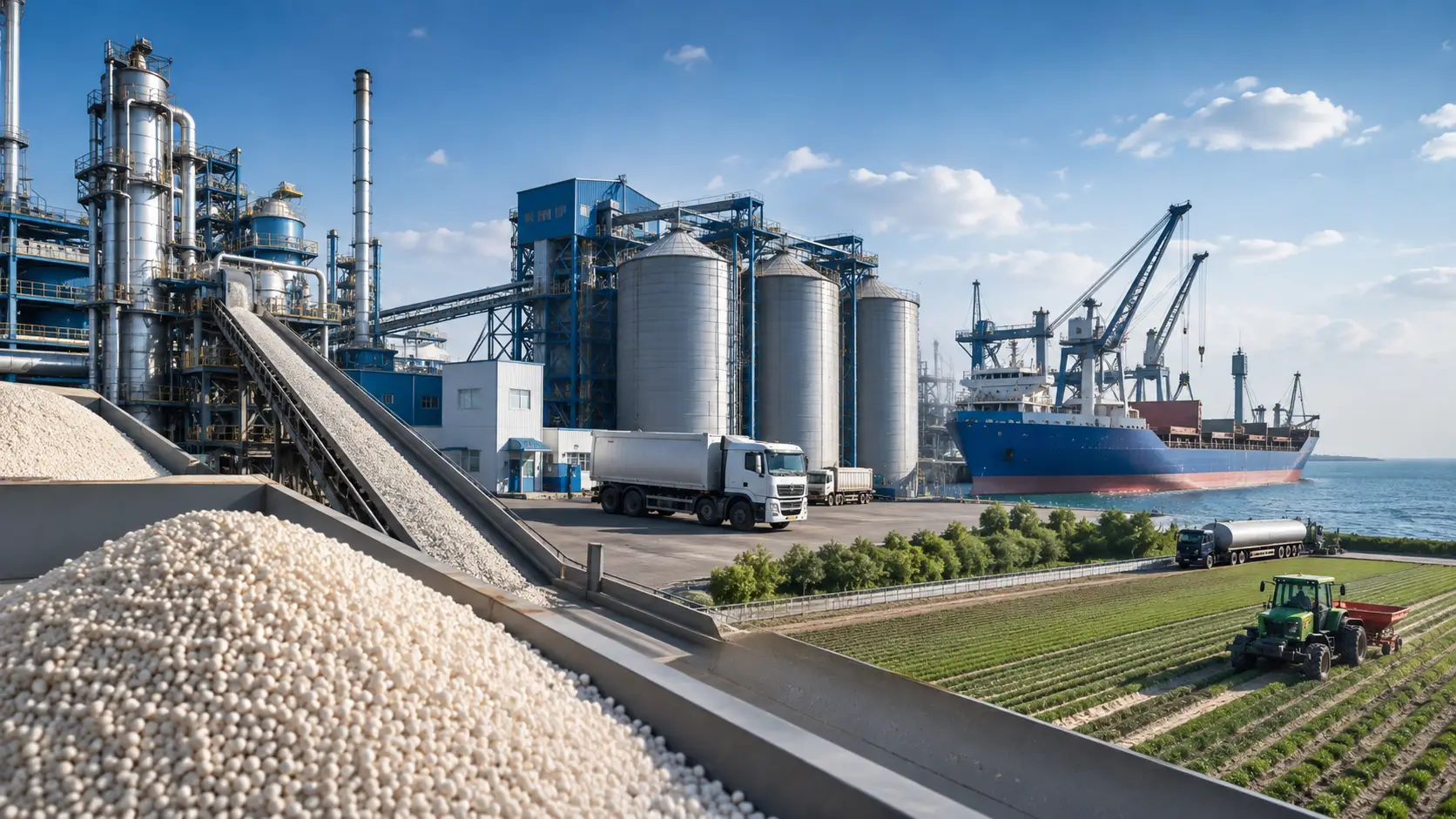
Introduction to the Diammonium Phosphate Supply Chain
Raw Materials and DAP Production
Global Production and Trade Dynamics
Logistics, Storage, and Distribution
Key Buyers and Procurement Requirements
Supply Chain Risks and Market Considerations
Strategic Sourcing of Diammonium Phosphate
Conclusion: Building a Reliable DAP Supply Strategy
Sources
Diammonium phosphate, commonly known as DAP, is an important phosphate-based chemical used primarily in fertilizer applications. Its supply chain connects upstream raw materials, chemical processing, bulk manufacturing, international trade, storage, distribution, and downstream agricultural demand. For B2B buyers, understanding this chain is essential because availability and purchasing economics can be influenced by several stages rather than by the finished product alone.
DAP is commercially important because it provides both nitrogen and phosphorus in a concentrated fertilizer product. This makes it relevant to agricultural input distributors, fertilizer blenders, importers, wholesalers, and organizations purchasing crop nutrients at industrial scale. Procurement teams therefore need to evaluate more than product availability when developing a dependable sourcing strategy.
International DAP procurement can involve multiple commercial parties, including producers, exporters, traders, shipping companies, port operators, distributors, and final industrial or agricultural users. Each participant can affect delivery timing, landed cost, documentation, and inventory planning. A buyer that understands these connections is better positioned to anticipate disruptions and negotiate contracts based on realistic supply conditions.
The modern phosphate fertilizer market also demonstrates why supply-chain resilience has become a strategic consideration. Recent market developments have highlighted the influence of trade restrictions, energy costs, logistics disruptions, and regional supply imbalances on fertilizer markets. For buyers, supplier diversification and forward planning can therefore be as important as obtaining a competitive initial quotation.
The DAP manufacturing chain begins with upstream inputs required to produce phosphate fertilizer. Phosphate rock represents the principal phosphorus-bearing mineral resource, while ammonia provides the nitrogen component. Sulfuric acid is also important within phosphate processing because it is used to manufacture phosphoric acid, a key intermediate in conventional phosphate fertilizer production.
The availability and cost of these upstream materials can influence the economics of finished DAP. Phosphate rock supply is connected to mining capacity and geological resources, while ammonia availability is closely connected to natural gas and other energy-market conditions. Consequently, changes in energy or mineral markets can eventually influence downstream DAP procurement conditions.
Industrial DAP production generally involves chemical reactions that combine ammonia and phosphoric acid, followed by processes that produce a granular or other commercially specified fertilizer product. Manufacturing facilities must manage reaction conditions, product consistency, granulation, drying, screening, and quality control to achieve specifications suitable for the intended market.
For B2B procurement, quality documentation is an important part of the manufacturing stage. Buyers may require specifications covering nutrient content, physical characteristics, moisture, particle size, packaging, and other parameters depending on the application. Food-grade or food-additive requirements are a separate consideration and should never be assumed from fertilizer-grade material.
DAP is traded internationally through established fertilizer supply networks linking major production regions with import-dependent agricultural markets. The international character of this supply chain means that purchasing decisions can be affected by production schedules, export policies, freight availability, port capacity, and regional demand cycles.
Long-term supply agreements have become particularly relevant in markets seeking to strengthen fertilizer security. Recent trade developments involving India and overseas producers illustrate how large buyers can use multi-year arrangements to secure DAP availability and reduce exposure to short-term supply disruptions. This approach can be particularly valuable for distributors and agricultural organizations with predictable annual consumption.
DAP demand is closely connected to agricultural production and fertilizer application cycles. Import requirements can increase when domestic production is insufficient or when governments and distributors seek to maintain strategic fertilizer inventories. Conversely, seasonal purchasing patterns and changes in crop economics can influence the timing and volume of orders.
For international buyers, market balance should therefore be evaluated at both global and regional levels. A product may be readily available in one exporting region while facing tighter conditions in another. Procurement teams that monitor regional supply, shipping routes, import requirements, and seasonal demand can make more informed purchasing decisions.
The logistics stage represents a major component of the DAP supply chain because international shipments may involve bulk vessels, containers, ports, warehouses, inland transportation, and final distribution networks. The preferred transportation method depends on shipment volume, destination, infrastructure, packaging format, and the buyer's inventory requirements.
For bulk purchasers, vessel scheduling and port availability can materially affect delivery performance. Containerized shipments may provide flexibility for smaller commercial orders, while bulk movements can be more appropriate for high-volume fertilizer distribution. Buyers should therefore evaluate freight terms and delivery windows alongside the quoted chemical price.
DAP inventory planning requires attention to storage conditions, handling procedures, packaging integrity, and stock rotation. Commercial buyers should establish appropriate warehouse procedures before receiving shipments and ensure that storage facilities are suitable for the product form and packaging selected.
Inventory strategy is particularly important when supply markets are volatile. Maintaining sufficient safety stock can protect downstream customers against shipping delays or temporary supplier constraints, but excessive inventory can increase working-capital exposure. The optimal approach depends on consumption rates, lead times, seasonal demand, supplier reliability, and the cost of replenishment.
The largest commercial demand for DAP is associated with fertilizer and agricultural supply chains. Buyers can include fertilizer distributors, agricultural input companies, importers, wholesalers, cooperatives, crop producers, and organizations responsible for large-scale fertilizer procurement. These customers generally prioritize dependable supply, consistent specifications, competitive landed cost, and delivery reliability.
B2B buyers may purchase DAP as a finished fertilizer for distribution or as an input within broader fertilizer programs. Procurement volumes can range from container-scale transactions to large bulk shipments. This creates different sourcing requirements, with smaller buyers emphasizing flexibility and documentation while larger buyers often focus on contract security, logistics planning, and supplier capacity.
Diammonium phosphate also has a recognized food-additive identity under INS 342(ii), with JECFA identifying functions including acidity regulation, flour treatment, raising-agent use, and yeast-food applications. However, these applications require appropriate food-grade material and regulatory compliance; fertilizer-grade DAP should not automatically be treated as suitable for food use.
For food and specialty chemical buyers, procurement specifications therefore extend beyond the basic chemical name. Documentation, purity requirements, regulatory status, manufacturing controls, traceability, and intended-use compliance can all influence supplier selection. Buyers should communicate the exact grade and application before requesting commercial offers.
DAP supply chains can be exposed to geopolitical developments, export restrictions, sanctions, port disruptions, freight-market changes, and shifts in trade policy. Because phosphate fertilizer production is concentrated in important producing regions, disruption in one major supply corridor can affect availability and pricing in distant importing markets.
Recent fertilizer-market conditions have demonstrated the importance of monitoring both commodity fundamentals and geopolitical factors. Higher phosphate prices, tighter trade conditions, energy-market changes, and shipping disruptions can influence supplier quotations and delivery schedules. Buyers should consequently avoid relying on a single sourcing route when their operations require continuous availability.
The final procurement cost of DAP is influenced by more than the producer's ex-works price. Freight, insurance, port charges, financing, customs requirements, inland transportation, packaging, handling, and currency movements can all contribute to the landed cost. A low product quotation may therefore not represent the lowest overall procurement cost.
Effective purchasing teams compare suppliers using a total-cost perspective. They should assess product price, freight, payment terms, minimum order quantities, lead time, documentation, and delivery reliability together. This approach provides a clearer basis for supplier comparison and reduces the risk of selecting an apparently inexpensive offer that becomes costly after logistics and operational factors are included.
A robust DAP sourcing strategy begins with supplier qualification. Buyers should examine manufacturing capability, product specifications, export experience, documentation, quality consistency, packaging options, logistics capability, and commercial reliability. Supplier capacity is especially important for buyers with recurring requirements because an attractive one-time quotation does not necessarily demonstrate long-term supply capability.
Procurement teams should also distinguish between fertilizer-grade and specialty or food-grade requirements before negotiations begin. Clearly defined specifications reduce misunderstandings and help suppliers provide comparable quotations. Where the material is intended for food applications, buyers should establish the required regulatory and quality documentation before purchase approval.
Supplier diversification can strengthen the DAP procurement model by reducing dependence on a single country, producer, port, or transportation route. Buyers with significant annual requirements can consider a combination of contracted supply and spot purchasing, allowing them to maintain baseline security while retaining some flexibility when market conditions change.
A B2B chemical marketplace can support this process by connecting buyers with international suppliers and facilitating commercial comparison. For procurement teams, the objective should not simply be to find the lowest available DAP quotation. The stronger objective is to establish a sourcing network that balances quality, price, availability, documentation, logistics, and long-term commercial reliability.
Diammonium phosphate procurement has evolved beyond a simple product-purchasing exercise. Its supply chain spans phosphate rock, ammonia, phosphoric acid, manufacturing, international transportation, storage, distribution, and agricultural demand. Each stage can influence commercial availability and landed cost, making supply-chain visibility increasingly important for professional buyers.
Market conditions also reinforce the value of proactive procurement. Buyers facing recurring DAP requirements should monitor upstream inputs, trade policies, regional demand, freight conditions, supplier capacity, and inventory levels. A structured approach can help procurement teams reduce disruption exposure while improving purchasing predictability.
For distributors, agricultural businesses, industrial users, and qualified specialty buyers, reliable access to diammonium phosphate depends on selecting suppliers that can align product specifications with commercial and logistical requirements. Tradeasia International can support B2B chemical sourcing by connecting buyers with international supply opportunities and helping procurement teams approach DAP purchasing with a broader view of product, market, and supply-chain considerations.
The strongest DAP sourcing strategy is ultimately one that combines reliable suppliers, transparent specifications, realistic logistics planning, and continuous market awareness. By treating the product as part of a broader supply network rather than as an isolated commodity, buyers can build a more resilient procurement process for changing international market conditions.
FAO – Fertilizer Specifications: Diammonium Phosphate (DAP)
We're committed to your privacy. Tradeasia uses the information you provide to us to contact you about our relevant content, products, and services. For more information, check out our privacy policy.


 English
 Indonesian
 简体字
简体字
 العربية
 Español
 Français
 Português
 日本語
日本語
 한국어
한국어
 Tiếng Việt



















