Explore our network of country and industry based websites to access localized information, product offerings, and business services across our group.
Log in to start sending quotation requests for any product.
Don't have an account? Sign Up Here
Home Market Intelligence for the Global Refined Sunflower Oil Supply Chain
Trade Insights | Supply Chain | 30 July 2026

Introduction to Refined Sunflower Oil Supply Chain
Global Production and Supply Network
Key Supply Chain Drivers and Market Influences
Procurement Challenges for Industrial Buyers
Strategic Sourcing and Supplier Selection
Future Opportunities in the Global Market
Conclusion
Sources
The refined sunflower oil market has become an essential component of the global food ingredient industry, serving manufacturers, distributors, retailers, and foodservice companies across numerous regions. Produced through refining crude sunflower oil to improve clarity, stability, taste, and shelf life, refined sunflower oil is widely valued for its light flavor, high smoke point, and balanced fatty acid profile. These qualities have strengthened its position as one of the preferred edible oils for industrial-scale food production.
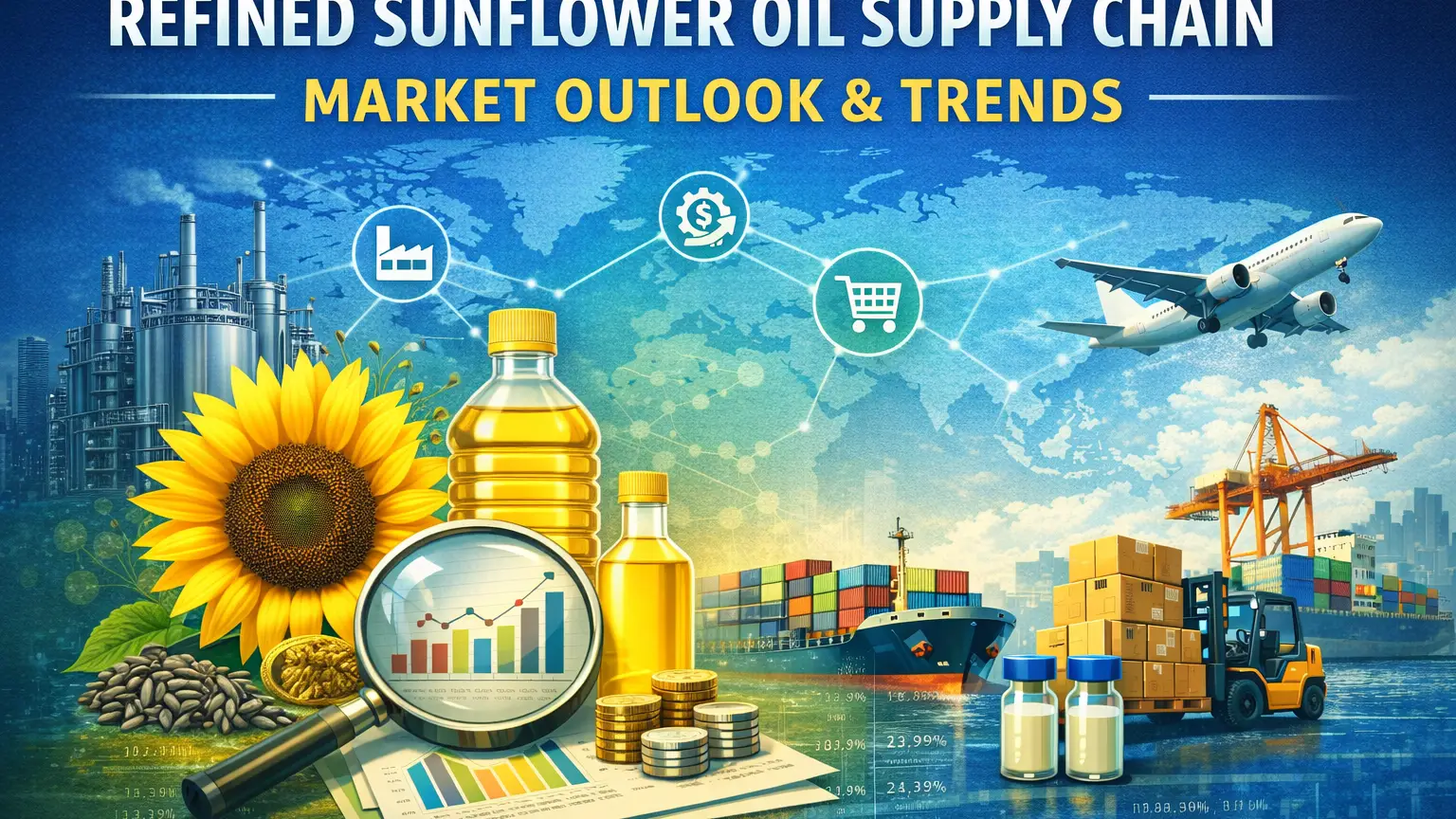
As international food manufacturing expands, supply chain transparency has become increasingly important for procurement professionals seeking reliable and sustainable ingredient sources. Refined sunflower oil travels through multiple stages, beginning with sunflower seed cultivation, followed by crushing, crude oil extraction, refining, storage, transportation, and finally global distribution. Each stage influences product quality, delivery schedules, and procurement costs.
Global buyers are paying closer attention to supply chain resilience as geopolitical events, climate conditions, logistics disruptions, and changing trade regulations continue to affect edible oil availability. Companies that understand these dynamics are better positioned to manage inventory risks while maintaining consistent production schedules and competitive pricing.
The increasing demand for traceable food ingredients has also encouraged suppliers to invest in quality management systems, sustainability initiatives, and digital supply chain monitoring. These developments allow manufacturers and procurement teams to establish stronger partnerships with dependable suppliers capable of delivering consistent product quality throughout changing market conditions.
Refined sunflower oil production begins with sunflower cultivation, where agricultural conditions significantly influence both yield and quality. Major producing regions benefit from fertile land, favorable climates, and well-established agricultural infrastructure, enabling efficient production of sunflower seeds for commercial processing. Harvest quality directly affects oil recovery rates and downstream refining efficiency.
Countries including Ukraine, Russia, Argentina, Romania, Bulgaria, Turkey, and several European nations have historically contributed significantly to global sunflower oil production. Processing facilities located near cultivation areas reduce transportation costs while supporting efficient conversion from harvested seeds into refined edible oil ready for international distribution.
International trade networks connect producers with food manufacturers throughout Asia, the Middle East, Europe, Africa, and the Americas. Export terminals, bulk storage facilities, and specialized food-grade logistics providers play critical roles in maintaining product integrity throughout long-distance transportation.
The diversification of supply origins has become increasingly important as buyers seek to minimize dependence on single-source procurement. Establishing relationships with suppliers across multiple production regions helps businesses reduce supply disruptions while maintaining stable purchasing strategies in a competitive global marketplace.
Numerous economic and environmental factors influence the refined sunflower oil supply chain, making market monitoring an essential activity for procurement professionals. Agricultural yields, weather conditions, input costs, transportation availability, exchange rates, and international trade policies collectively determine supply availability and pricing trends.
Seasonal harvest cycles remain one of the primary factors affecting market supply. Strong harvests typically improve availability and support stable pricing, while droughts, excessive rainfall, or adverse weather events may reduce production volumes and create temporary supply constraints. Energy costs also influence refining expenses, packaging operations, and freight rates throughout the distribution network.
Consumer demand continues to evolve as food manufacturers respond to preferences for healthier cooking oils with favorable nutritional characteristics. This sustained demand encourages investments in refining technologies, production capacity expansion, and quality assurance systems that enhance long-term supply reliability.
For industrial buyers, successful procurement increasingly depends on combining market intelligence with supplier diversification, contractual planning, and inventory management. Organizations that continuously monitor supply chain developments are better equipped to respond to market volatility while securing reliable sources of refined sunflower oil for ongoing manufacturing operations.
Industrial procurement teams face increasing complexity when sourcing refined sunflower oil due to fluctuating raw material availability, geopolitical developments, freight costs, and evolving food safety regulations. While refined sunflower oil remains one of the most widely traded edible oils, maintaining uninterrupted supply requires buyers to anticipate potential disruptions and develop resilient sourcing strategies. Procurement decisions are no longer driven solely by price but also by supplier reliability, product consistency, and logistical efficiency.
One of the primary challenges is balancing cost competitiveness with dependable supply. Weather-related reductions in sunflower seed harvests can tighten global inventories, while port congestion and transportation delays may extend delivery lead times. These factors make accurate demand forecasting and proactive procurement planning increasingly important for food manufacturers and distributors.
Industrial buyers must also comply with stringent food safety standards, import regulations, and quality certification requirements. Suppliers capable of providing comprehensive documentation, including certificates of analysis, traceability records, and compliance with internationally recognized food safety management systems, help reduce operational risks and simplify regulatory approval processes.
Long-term supplier relationships have become an effective risk management strategy. By collaborating with experienced exporters and maintaining diversified sourcing portfolios across multiple production regions, organizations can better withstand temporary market disruptions while ensuring continuous production schedules and stable product availability.
Selecting the right refined sunflower oil supplier involves more than evaluating pricing. Procurement professionals increasingly assess suppliers based on production capacity, quality assurance practices, export experience, supply reliability, and responsiveness to changing market conditions. A comprehensive sourcing strategy enables businesses to secure consistent product quality while optimizing procurement costs over the long term.
Reliable suppliers maintain integrated supply chains that encompass raw material sourcing, refining operations, quality control, storage, and international logistics. Such integration enhances consistency across production batches and minimizes variability that could affect downstream food manufacturing processes.
Global buyers also value suppliers with flexible packaging options, including bulk tankers, flexitanks, drums, intermediate bulk containers (IBCs), and retail packaging solutions. This flexibility allows manufacturers, distributors, and private-label businesses to tailor procurement according to production volumes and regional distribution requirements.
Digital procurement platforms and B2B marketplaces further simplify supplier evaluation by improving transparency, facilitating quotation comparisons, and enabling direct communication with qualified exporters. As procurement continues to digitalize, buyers benefit from faster sourcing decisions, improved documentation management, and stronger collaboration throughout the purchasing cycle.
The outlook for the refined sunflower oil market remains positive as global food consumption, urbanization, and demand for premium edible oils continue to grow. Expanding populations, increasing disposable incomes, and the development of modern food processing industries are expected to sustain long-term demand across both established and emerging markets.
Technological advancements are transforming every stage of the refined sunflower oil supply chain. Precision agriculture, satellite-based crop monitoring, predictive analytics, and automated refining technologies are improving production efficiency while helping suppliers respond more effectively to changing market conditions.
Sustainability initiatives are also influencing procurement decisions. Buyers increasingly prefer suppliers that demonstrate responsible agricultural sourcing, efficient resource utilization, reduced carbon emissions, and environmentally responsible manufacturing practices. These initiatives strengthen supplier credibility while supporting corporate environmental, social, and governance (ESG) objectives.
As international trade networks continue to diversify, businesses that combine strategic sourcing, digital supply chain visibility, and partnerships with experienced global suppliers will be better positioned to manage market volatility and capitalize on future growth opportunities in the refined sunflower oil industry.
Refined sunflower oil remains a cornerstone ingredient within the global food manufacturing industry, supported by an extensive international supply chain connecting agricultural producers, processors, exporters, logistics providers, and industrial buyers. Although market conditions continue to evolve due to climatic, economic, and geopolitical factors, organizations that prioritize supply chain visibility, supplier diversification, and strategic procurement planning can significantly improve operational resilience and purchasing efficiency.
For manufacturers, distributors, wholesalers, and procurement teams, selecting an experienced global sourcing partner is essential to maintaining consistent product quality and reliable deliveries. Comprehensive market knowledge, established international supplier networks, and efficient logistics capabilities enable businesses to respond quickly to changing demand while minimizing supply chain risks.
Tradeasia International, through the Chemtradeasia and Tradechem Marketplace platforms, connects global buyers with dependable suppliers of refined sunflower oil and other industrial products. By leveraging extensive international sourcing expertise, robust quality management practices, and integrated logistics support, Tradeasia helps businesses optimize procurement processes and establish reliable long-term supply partnerships in today's competitive global marketplace.
We're committed to your privacy. Tradeasia uses the information you provide to us to contact you about our relevant content, products, and services. For more information, check out our privacy policy.


 English
 Indonesian
 简体字
简体字
 العربية
 Español
 Français
 Português
 日本語
日本語
 한국어
한국어
 Tiếng Việt