Explore our network of country and industry based websites to access localized information, product offerings, and business services across our group.
Log in to start sending quotation requests for any product.
Don't have an account? Sign Up Here
Home Vital Wheat Gluten: Applications, Demand and B2B Sourcing Trends
Trade Insights | Supply Chain | 07 September 2026
Vital Wheat Gluten and Its Commercial Role
Industrial Applications Driving Vital Wheat Gluten Demand
Market and Application Trends for Wheat Gluten
Buyer Intent and Procurement Considerations
B2B Sourcing and Supply Chain Opportunities
Commercial Positioning of Vital Wheat Gluten
Conclusion: Building a Reliable Vital Wheat Gluten Supply Strategy
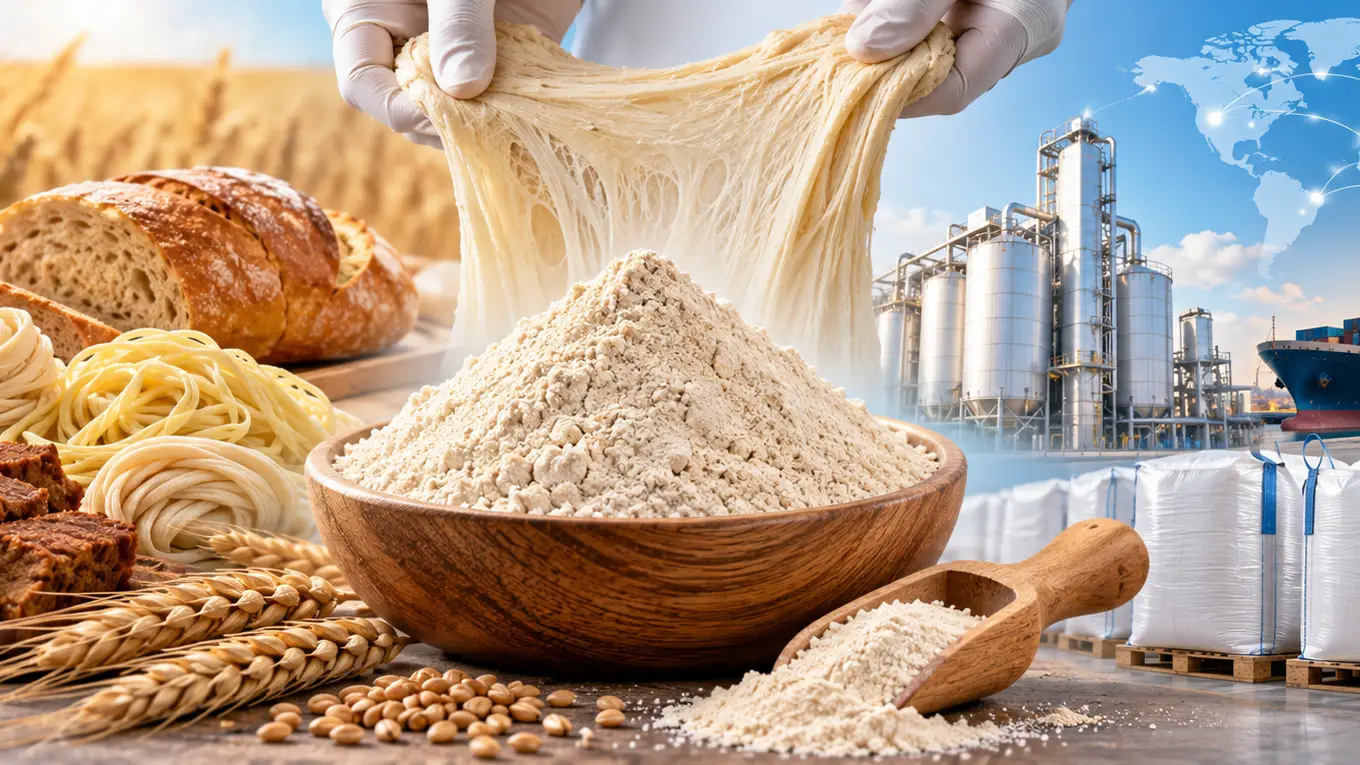
Vital Wheat Gluten is a concentrated wheat-protein ingredient produced by separating much of the starch from wheat flour and retaining the elastic gluten fraction. The product listed by Tradeasia has a minimum assay of 75% protein on a dry basis, is supplied as a white to off-white solid, and is insoluble in water. The product page identifies its origin as China and lists CAS Number 8002-80-0 and HS Code 1109.00.00.
From a functional perspective, wheat gluten is distinguished by its protein structure and ability to form cohesive, elastic networks. Scientific literature identifies gluten as the dough-forming protein system responsible for important technological characteristics in wheat-based foods, particularly its ability to support dough development and gas retention. These characteristics explain why Vital Wheat Gluten has become an established ingredient in commercial food processing.
The Tradeasia product specification positions Vital Wheat Gluten as a pure-substance solid with a minimum protein content of 75% on a dry basis. Its manufacturing description states that wheat flour is hydrated and kneaded underwater to agglomerate gluten, after which the gluten mass is separated, mechanically dewatered, dried, sieved, and milled. The resulting product contains approximately 7% moisture according to the supplied product information.
For B2B buyers, these characteristics make Vital Wheat Gluten more than a commodity ingredient: it is a functional wheat-protein input whose commercial value depends on how consistently it performs in the target formulation. Research comparing commercial Vital Wheat Gluten samples has found that differences in protein characteristics and structure can influence gluten-network development and technological performance, reinforcing the importance of evaluating specifications and supplier consistency during procurement.
Vital Wheat Gluten has its strongest established position in food processing, particularly where wheat-protein functionality is required. Its commercial applications include bakery products and other wheat-based foods, while more recent food-product development has expanded interest toward plant-based products and meat analogues. Technical literature continues to identify bakery as a core application while highlighting broader opportunities for wheat proteins.
Bakery remains one of the most important applications for Vital Wheat Gluten because additional gluten can help strengthen flour systems and improve dough functionality. A review of whole-wheat bread production found that Vital Wheat Gluten can address some of the technological challenges associated with whole-wheat formulations, including limitations in loaf volume and texture. This makes the ingredient commercially relevant to processors seeking greater consistency in flour-based production.
The value proposition for industrial bakeries is therefore closely connected to formulation control. Flour quality can vary according to raw material characteristics, while different finished products require different dough properties. Adding a concentrated wheat-protein ingredient can provide formulators with another tool for managing protein functionality rather than relying exclusively on the intrinsic characteristics of the base flour.
For manufacturers sourcing Vital Wheat Gluten, the application determines how specifications should be assessed. A bakery producer may focus particularly on protein level, moisture, physical consistency, and functional performance, while a plant-based food manufacturer may place greater emphasis on texturization behavior and interaction with other proteins. The appropriate procurement specification should therefore be connected to the intended end product rather than treated as a generic ingredient requirement.
The broader wheat-protein landscape is developing beyond traditional bakery applications. Recent scientific literature describes wheat proteins as functional and nutritional ingredients with applications extending into food, dairy alternatives, feed, and meat-alternative products. At the same time, research into gluten structure and processing continues to explore ways of controlling functionality for new food applications.
Plant-based food development is an important application trend for Vital Wheat Gluten because its structural properties can contribute to meat-like textures. Research on plant-based meat analogues identifies wheat gluten as both a binder and structuring ingredient, with extrusion and related processing approaches capable of producing fibrous structures. This gives wheat gluten relevance in formulations designed to replicate the texture of conventional meat products.
Recent research also indicates that wheat gluten remains relevant to the continuing technical development of plant-based meat products. Its interaction with other plant proteins, including soy protein, can influence the development of fibrous structures, while processing conditions can be used to modify the resulting texture. These developments create potential demand from food manufacturers that require functional proteins rather than simply nutritional protein sources.
At the same time, market opportunity should not be interpreted as universal suitability. Gluten is a wheat-derived protein and is not appropriate for gluten-free formulations or consumers who must avoid gluten. For procurement and product-development teams, this distinction is commercially important because application specifications, labeling requirements, and target consumer segments must remain aligned throughout product development and sourcing.
The primary buyers of Vital Wheat Gluten are likely to be food manufacturers, commercial bakeries, ingredient distributors, plant-based food producers, formulation teams, and procurement organizations that require wheat-protein functionality at an industrial scale. Their purchase decisions are generally driven by the requirements of the finished application, the consistency of the ingredient, commercial terms, and the reliability of the supply relationship.
A procurement team evaluating a Vital Wheat Gluten supplier typically needs to establish whether the material meets its technical specification before comparing commercial factors. Relevant considerations can include protein content, moisture, physical form, origin, storage requirements, documentation, packaging, order quantity, delivery capability, and suitability for the intended manufacturing process. The Tradeasia listing specifies a minimum 75% protein content on a dry basis, solid form, China origin, and cool, dry, sealed storage conditions.
Supplier comparison is particularly important when the ingredient plays a functional role in the finished product. Scientific research has shown that commercial Vital Wheat Gluten samples from different origins can exhibit differences in protein composition and structural characteristics. Consequently, buyers may need to assess not only nominal specifications but also whether the material can deliver repeatable performance within their formulation and processing conditions.
For commercial buyers, the Vital Wheat Gluten supplier information provides a direct starting point for evaluating the listed material and submitting an inquiry concerning quantity, pricing, customization, and shipping. This is particularly relevant for procurement teams that need to move from application research to an actual sourcing discussion.
Reliable sourcing is increasingly important when Vital Wheat Gluten is used as a functional input rather than a minor formulation component. Manufacturers need confidence that incoming material can meet established specifications and that supply arrangements support production planning. The commercial supply chain therefore connects technical quality with availability, logistics, documentation, and supplier responsiveness.
A B2B marketplace can reduce friction between manufacturers seeking wheat-protein ingredients and suppliers capable of supporting industrial requirements. For a buyer, the objective is not simply to locate Vital Wheat Gluten but to identify a supply option that aligns with the application, quantity requirement, technical specification, and delivery expectations. This makes structured product information an important part of the sourcing process.
The product information supplied for Vital Wheat Gluten includes identification, protein specification, physical characteristics, storage conditions, regulatory status, manufacturing information, and an inquiry mechanism. These details can help procurement and technical teams establish an initial screening framework before engaging suppliers directly.
The opportunity for manufacturers, traders, and distributors lies in connecting application-specific demand with dependable supply. Bakery producers may require the ingredient for dough and flour performance, while plant-based food manufacturers may evaluate it for textural functionality. As these requirements differ, effective B2B sourcing should preserve a clear connection between the buyer's end-use requirements and the supplier's technical offering.
Vital Wheat Gluten has commercial relevance because it combines concentrated wheat-protein content with functionality that can support multiple food-processing applications. Its established bakery role provides a stable industrial use case, while plant-based food development creates additional opportunities for manufacturers looking for structuring proteins. Scientific literature published in recent years continues to investigate wheat gluten functionality, processing, and new applications.
For procurement teams, the commercial question is whether Vital Wheat Gluten can provide the required functionality at the required specification and supply conditions. Buyers may therefore approach the category through different needs: bakery formulation, plant-based product development, ingredient distribution, or broader food-protein sourcing. Each route creates a different combination of technical and commercial evaluation criteria.
Tradeasia's marketplace positioning can support this process by providing a centralized product reference through its Vital Wheat Gluten sourcing page. The listed product information includes a technical document reference and an inquiry process for pricing, customization, shipping, and quantity requirements, giving prospective buyers a pathway from research toward commercial engagement.
The strongest commercial positioning is therefore application-led rather than purely product-led. A buyer searching for a Vital Wheat Gluten supplier is often trying to solve a manufacturing requirement, not merely identify the definition of wheat gluten. By connecting product specifications with bakery, plant-based, and other food-processing applications, a B2B marketplace can make supplier discovery more relevant to procurement decision-making.
Vital Wheat Gluten occupies an established position in industrial food production because its wheat-protein functionality can contribute to dough performance, structure, binding, and texture. Bakery remains a central application, while plant-based foods and meat alternatives represent important areas of continued technical development. Recent scientific work demonstrates that researchers are still investigating gluten structure, processing behavior, and new functional applications.
For buyers, the key consideration is matching product characteristics with the intended application. Protein specification, moisture, physical form, origin, storage requirements, technical documentation, and supply capability can all form part of the procurement assessment. The Tradeasia listing provides these baseline details while allowing buyers to request further commercial information.
A disciplined sourcing process can help manufacturers compare suppliers based on both technical suitability and commercial reliability. This is particularly relevant when Vital Wheat Gluten becomes an important component of production, because variations in gluten characteristics can affect processing performance and finished-product outcomes. Supplier evaluation should consequently extend beyond price to include specification consistency and supply-chain capability.
For manufacturers, distributors, traders, and procurement teams seeking a B2B Vital Wheat Gluten supplier, Tradeasia provides a marketplace-oriented route for moving from product research to sourcing inquiry. Buyers can review the Vital Wheat Gluten product page and use the available inquiry process to discuss quantity, pricing, customization, and shipping requirements. As food manufacturers continue to evaluate functional protein ingredients across established and emerging applications, reliable sourcing remains an important part of turning market demand into dependable production supply.
We're committed to your privacy. Tradeasia uses the information you provide to us to contact you about our relevant content, products, and services. For more information, check out our privacy policy.


 English
 Indonesian
 简体字
简体字
 العربية
 Español
 Français
 Português
 日本語
日本語
 한국어
한국어
 Tiếng Việt



















