Explore our network of country and industry based websites to access localized information, product offerings, and business services across our group.
Log in to start sending quotation requests for any product.
Don't have an account? Sign Up Here
Home Vital Wheat Gluten Supply Chain and Global B2B Sourcing
Trade Insights | Supply Chain | 02 September 2026
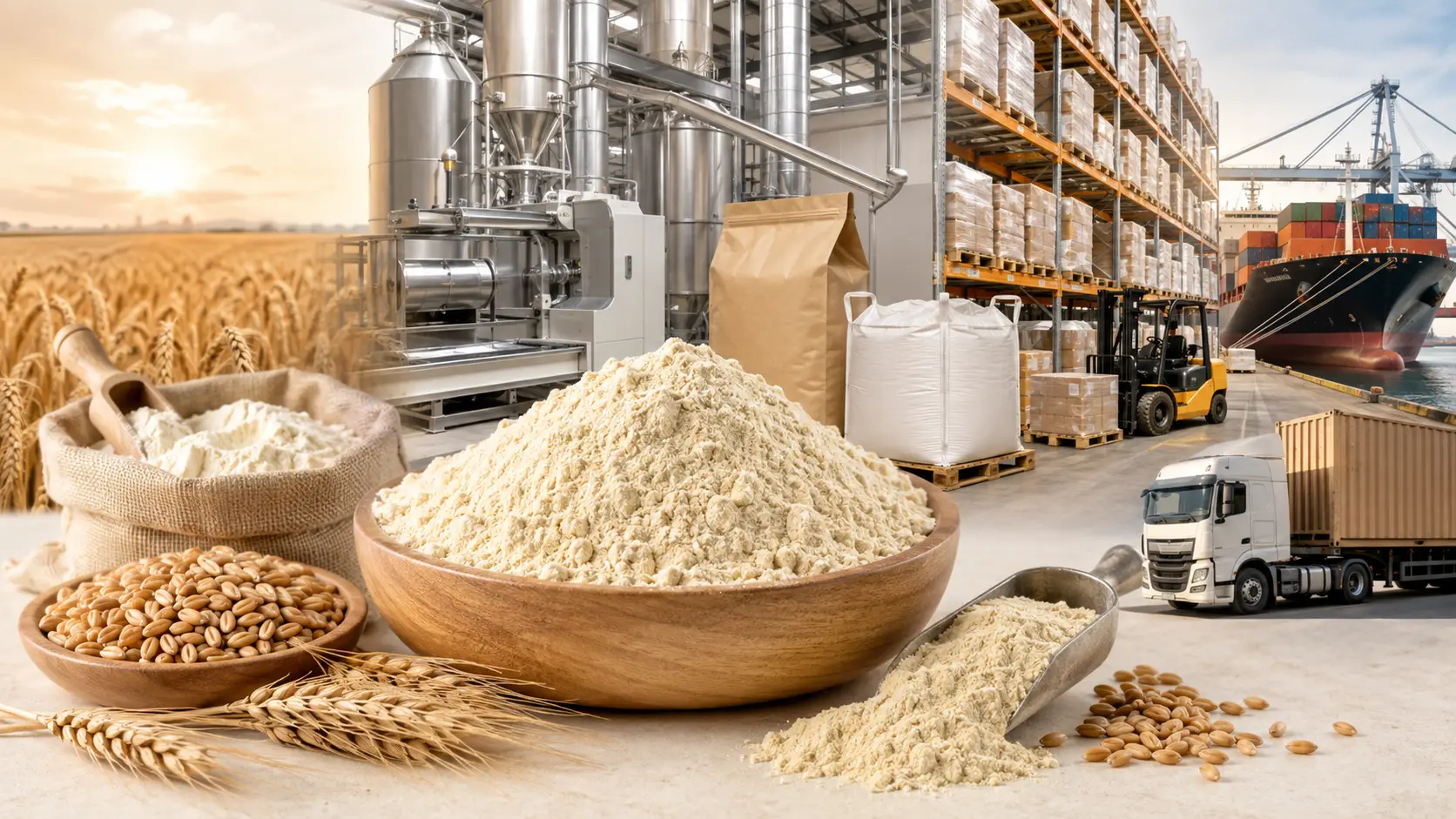
Global Vital Wheat Gluten Supply Chain Overview
Wheat Sourcing and Raw Material Availability
Milling and Vital Wheat Gluten Production
Quality Control and Commercial Specifications
International Logistics and Distribution
B2B Buyers and Procurement Considerations
Market Outlook and Strategic Sourcing
Conclusion
Sources
Vital Wheat Gluten is a functional wheat-derived protein ingredient positioned within the broader global wheat and food-ingredient supply chain. Its commercial value comes from its ability to provide protein, structure, strength, water absorption, and viscoelastic functionality in food formulations. ADM, for example, identifies applications across baked goods, cereals, pasta and noodles, sauces, fillings, and meat alternatives.
The supply chain begins with agricultural wheat production and moves through grain collection, storage, milling, gluten separation, drying, packaging, warehousing, and international distribution. Because Vital Wheat Gluten is a processed ingredient rather than a raw agricultural commodity, buyers need to evaluate both wheat-market conditions and the manufacturing capabilities of suppliers. This makes sourcing strategy particularly important for food manufacturers purchasing at commercial or industrial volumes.
Global wheat availability provides an important upstream indicator for the ingredient. USDA's 2026 wheat outlook continues to monitor global production, consumption, stocks, imports, and exports, while its January 2026 outlook projected 219.7 million metric tons of global wheat exports for the 2025/26 trade year. These large international flows create the agricultural foundation from which wheat-based ingredients such as Vital Wheat Gluten are produced.
For B2B buyers, the supply chain therefore needs to be assessed as an integrated system rather than as an isolated ingredient purchase. Origin, wheat quality, processing capacity, specification consistency, packaging, shipping route, lead time, and documentation can all affect procurement performance. A reliable sourcing strategy connects upstream agricultural availability with downstream production requirements and customer demand.
Wheat is the primary raw material behind Vital Wheat Gluten, making agricultural sourcing one of the first determinants of supply-chain performance. Wheat varieties with suitable protein and gluten characteristics are particularly relevant because the functionality of the finished ingredient depends heavily on the properties of the wheat entering the milling and separation process. This creates a direct connection between crop quality and food-ingredient performance.
International wheat sourcing is geographically diversified. USDA reporting shows that major producing and exporting regions continue to influence global wheat availability, while individual importing countries may prioritize different origins according to price, quality, logistics, and established supplier relationships. For Vital Wheat Gluten buyers, this means that supply continuity can depend on both the physical availability of wheat and the supplier's ability to maintain appropriate raw-material specifications.
The choice of wheat origin can influence protein concentration, gluten functionality, milling performance, and ultimately the consistency of the finished ingredient. Commercial buyers should therefore avoid treating origin simply as a geographic label. Instead, origin should be evaluated alongside technical specifications, historical consistency, supplier controls, and the intended application.
Weather variability, harvest conditions, export policies, currency movements, freight costs, and regional demand can all affect wheat procurement economics. FAO's Food Outlook published in November 2025 noted expectations for broad-based increases in global food commodity production while also highlighting weather variability and an uncertain trade environment as potential risks. These factors reinforce the importance of diversified sourcing and forward procurement planning.
After wheat is sourced and received, it enters a controlled milling and ingredient-processing chain. Flour milling separates components of the grain, while specialized processing can further separate wheat protein from other flour constituents. Vital Wheat Gluten is then dried and processed into a stable ingredient suitable for transportation, storage, and incorporation into food formulations.
The production stage is commercially important because processing consistency determines whether buyers receive a material that performs predictably from shipment to shipment. ADM describes Vital Wheat Gluten as a wheat protein with viscoelastic properties and highlights its ability to increase water absorption, support structure development, improve dough machinability, and enhance fermentation tolerance.
Manufacturing scale can also influence supply reliability. Large processors with established wheat procurement networks may be able to manage raw-material variation and maintain continuous production more effectively, while specialized suppliers can provide formulations or grades designed for particular applications. For international buyers, the production location also determines the most practical export corridors and delivery times.
From a procurement perspective, production capacity should be considered alongside inventory strategy. A supplier that can maintain consistent production, hold appropriate finished-goods inventory, and coordinate export documentation may provide greater commercial value than a supplier offering only an attractive spot price. This becomes especially relevant when Vital Wheat Gluten is incorporated into continuous bakery, pasta, cereal, or plant-protein production.
Quality control for Vital Wheat Gluten extends beyond basic identity testing. Food manufacturers typically need consistent functional behavior because the ingredient can influence dough strength, water absorption, texture, binding, and protein enrichment. ADM's commercial materials describe Vital Wheat Gluten products with protein levels of 80% or higher in certain grades, while another ADM technical document lists a Vital Wheat Gluten specification of 82% minimum protein for a fermentation-nutrient application.
The required specification depends on the final application and purchasing agreement. Bakery manufacturers may prioritize gluten strength, absorption, fermentation tolerance, and dough handling, while pasta manufacturers may focus on structure and reduced breakage. Meat-alternative manufacturers can place greater emphasis on protein contribution, binding, texture, and flavor neutrality.
For international B2B transactions, technical documentation is a central component of quality assurance. Buyers may need product specifications, certificates of analysis, food-safety documentation, allergen information, origin details, packaging information, and other documents required by their internal quality systems or destination-market regulations.
Consistency between samples and commercial shipments is equally important. Procurement teams should compare specifications against actual application requirements rather than selecting solely on headline protein content. A supplier's ability to provide stable quality across repeated shipments can reduce reformulation risk, production interruptions, and quality disputes, making technical consistency a strategic supply-chain consideration.
Once Vital Wheat Gluten has passed quality control and packaging, logistics becomes the next major stage of the international supply chain. Depending on order size and destination, shipments may move through containerized ocean freight, regional distribution networks, or other commercial transport channels. Packaging format and shipment configuration should be aligned with the buyer's storage capacity and manufacturing schedule.
Freight economics can materially influence delivered cost because Vital Wheat Gluten is a processed, packaged food ingredient rather than bulk grain. Ocean freight, port handling, inland transportation, customs procedures, insurance, storage, and destination charges can all contribute to the final landed cost. Buyers should therefore compare suppliers using delivered economics rather than relying only on the quoted product price.
Distribution strategy becomes especially important for buyers operating in markets that depend on imported food ingredients. Regional warehouses or established distribution partners can shorten replenishment times and provide greater flexibility when international freight schedules change. This can be particularly valuable for manufacturers with regular production cycles.
International wheat trade itself demonstrates how supply routes respond to market conditions. USDA's January 2026 outlook projected global wheat imports of 215.7 million metric tons for the 2025/26 trade year and identified changes in import expectations across markets including Japan, Morocco, Saudi Arabia, and Vietnam. Vital Wheat Gluten buyers operate within this broader logistics environment, making route diversification and inventory planning important parts of procurement management.
Vital Wheat Gluten is relevant to several food-industry buyer segments because of its multifunctional protein and structural properties. Bakery manufacturers can use it to support dough strength and machinability, while pasta and noodle producers can use wheat gluten functionality to support product structure. Cereals and bars can also benefit from protein enrichment and binding characteristics.
Plant-based food manufacturers represent another important buyer group. Wheat protein can contribute texture and structure to meat-alternative formulations, with ADM specifically describing Vital Wheat Gluten as suitable for meat alternatives alongside bakery, cereal, pasta, sauce, and filling applications. This creates opportunities for suppliers serving both traditional food manufacturers and emerging plant-protein businesses.
B2B procurement teams generally need to evaluate more than price when selecting a Vital Wheat Gluten supplier. Protein content, functional performance, food-safety documentation, origin, packaging, minimum order quantities, production capacity, lead time, payment terms, and shipping options can all influence the commercial suitability of an offer.
A strong purchasing process should also evaluate supplier responsiveness and repeatability. For manufacturers, an ingredient that performs consistently can reduce production variability and simplify formulation management. Buyers should therefore establish clear technical specifications before negotiating commercial terms, then compare suppliers on total delivered value, supply continuity, documentation quality, and application suitability.
The Vital Wheat Gluten market is closely linked to the underlying wheat economy. USDA's 2026 outlook series continues to track wheat production, utilization, trade, and stocks as fundamental indicators for the global wheat market. FAO likewise identifies production, consumption, inventories, and international trade as key components of the global food-commodity outlook.
This relationship means buyers should monitor upstream wheat developments even when purchasing processed gluten rather than grain. Changes in wheat availability can affect raw-material costs, while changes in freight, energy, currency, and regional food demand can influence the final economics of imported Vital Wheat Gluten. A procurement team that monitors these variables can make more informed purchasing decisions.
For global B2B buyers, strategic sourcing should focus on supplier diversification, specification management, demand forecasting, and logistics planning. Maintaining qualified alternatives across different origins or supply channels can reduce dependence on a single source, while forward planning can help manufacturers manage periods of tight availability or unfavorable freight conditions.
Trade marketplaces can support this process by connecting buyers with suppliers and helping procurement teams evaluate commercial options according to application requirements, quantity, destination, and delivery expectations. For manufacturers and distributors seeking Vital Wheat Gluten, the most effective approach is to combine technical evaluation with commercial due diligence and supply-chain visibility.
Vital Wheat Gluten represents a specialized food ingredient whose supply chain begins with wheat cultivation and extends through milling, protein separation, quality control, packaging, international logistics, and industrial procurement. Its functional role in bakery products, pasta and noodles, cereals, sauces, fillings, and plant-based foods makes consistent supply particularly important for manufacturers.
The broader wheat market remains a critical upstream indicator. Current USDA assessments show substantial international wheat trade, while FAO continues to monitor production, consumption, stocks, and trade conditions across major agricultural commodities. For Vital Wheat Gluten buyers, these market fundamentals should be incorporated into sourcing and inventory decisions.
Successful procurement ultimately depends on matching technical requirements with dependable commercial supply. Buyers should evaluate protein and functional specifications, quality documentation, supplier capacity, packaging, logistics, lead times, and total landed cost before selecting a long-term sourcing partner.
For companies looking to strengthen their international ingredient procurement, Tradeasia International can serve as a B2B sourcing and supply-chain partner, helping connect commercial requirements with suitable global supply opportunities. Through a structured marketplace approach, buyers can explore sourcing options for Vital Wheat Gluten while keeping application needs, documentation, logistics, and procurement efficiency at the center of the purchasing process.
We're committed to your privacy. Tradeasia uses the information you provide to us to contact you about our relevant content, products, and services. For more information, check out our privacy policy.


 English
 Indonesian
 简体字
简体字
 العربية
 Español
 Français
 Português
 日本語
日本語
 한국어
한국어
 Tiếng Việt



















